


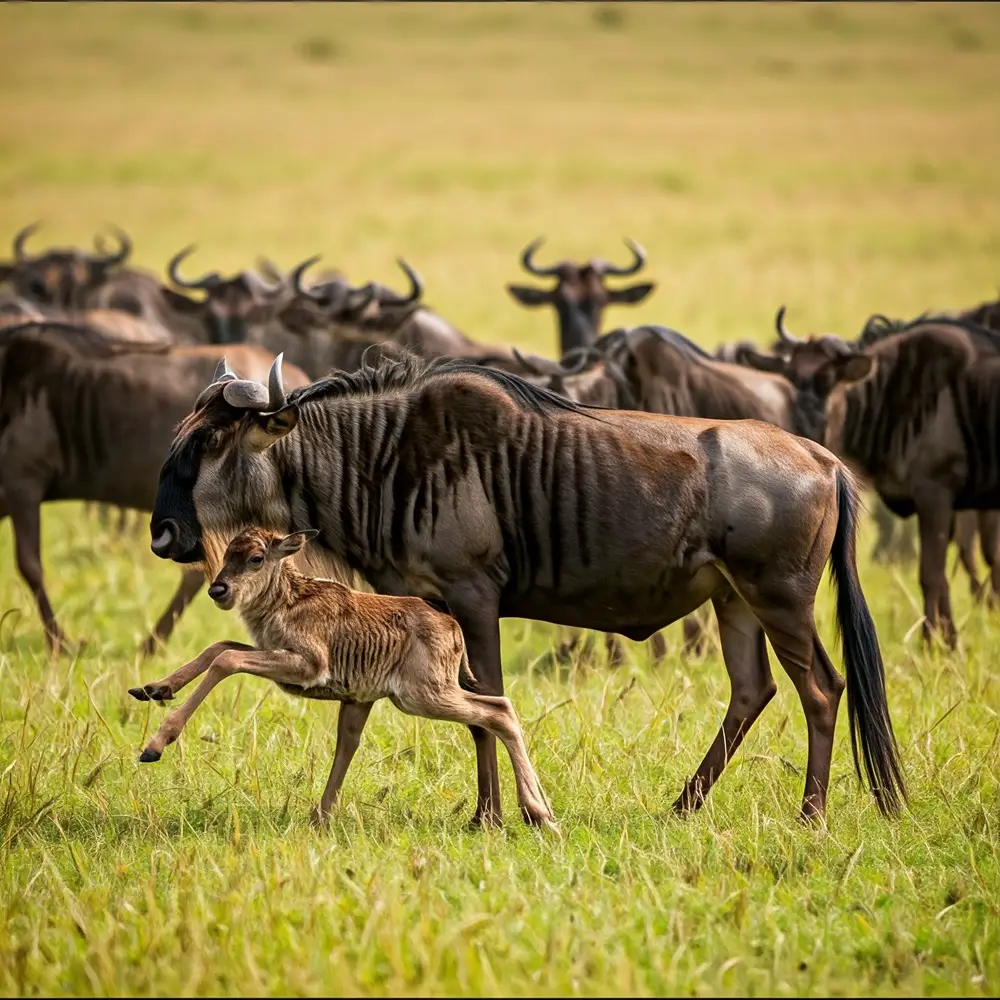
Two experiences, and you are wondering which to choose: Serengeti Calving vs Mara River Crossing. Both are interesting, but each offers different experiences. Imagine watching a newborn wildebeest struggle to its feet on the golden-green plains of the Serengeti National Park, its mother standing protectively beside it as thousands of animals graze across the horizon. Also picture yourself at the Mara River crossing, witnessing enormous herds gathering along the banks of the Mara River, hesitating before plunging into crocodile-inhabited waters in a desperate attempt to reach the opposite bank; these are completely different scenes invoking different emotions and overall experiences. Both scenes are part of the extraordinary Great Wildebeest Migration, yet they offer very different safari experiences.
The Serengeti calving season celebrates new life, maternal behaviour, and the intense predator activity surrounding newborn wildebeest, whereas the river crossing season, particularly around the Mara River, is famous for dramatic herd movements, dangerous water crossings and the unpredictable tension of animals deciding when to cross.
So, which is better for your Tanzania safari? Should you travel between January and March to witness the calving season, or visit between July and October for the possibility of seeing the famous Mara River crossings? This answer depends on what you want to experience, the wildlife encounters that interest you most, and how much flexibility you have with your travel dates.
Our safari experts at Gorilla Hour Uganda help visitors plan their Serengeti safari around the seasonal movements of wildlife, matching the right destinations, accommodation, and guiding arrangements to their interests. Choosing Serengeti Calving vs Mara River Crossing entirely depends on you.
Serengeti Calving vs Mara River Crossing Season at a Glance
Serengeti Calving vs Mara River Crossing safari difference is plain and simple: Serengeti calving season safari is about newborn wildlife and predator-prey interactions, while the Mara River Crossing season is about the movement of enormous herds through dangerous waterways.
Serengeti calving season happens between December and March, with many births happening during January, feb and March; all this happens in the Southern Serengeti and Ndutu plains, which is often greener, with seasonal rainfall possible. Here, the main attraction is Newborn wildebeest and maternal behaviour.
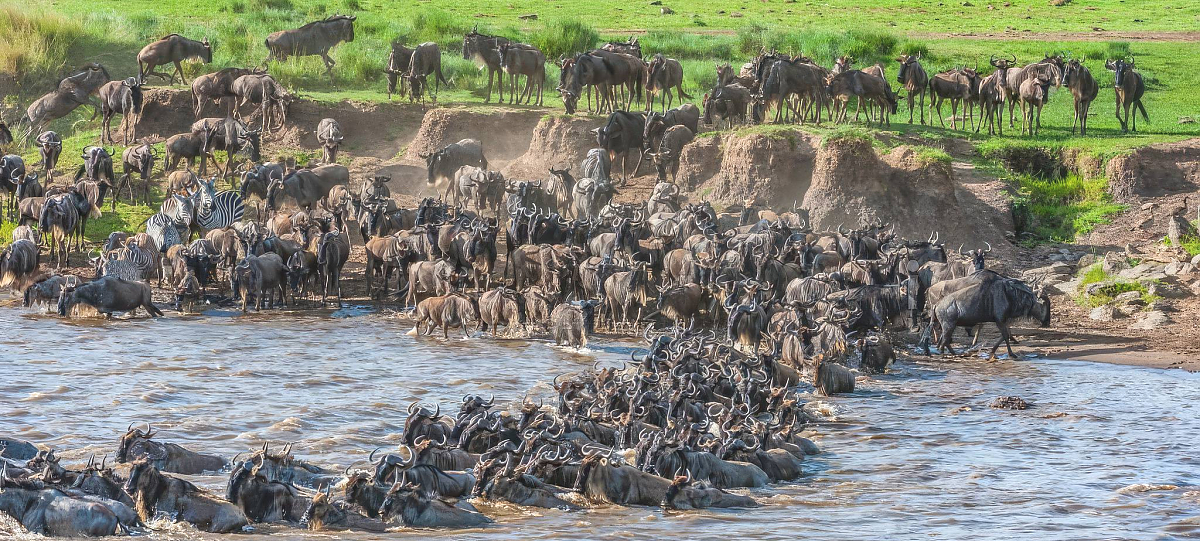
Whereas the Mara River crossing is about Wildebeest and zebra attempting river crossings. Usually between July–October, this happens in the Northern Serengeti around the Mara River. This time is the dry season, and the landscape is drier; the primary focus is on the moving herds and riverine wildlife such as crocodiles. Herds gather at the Mara River for a dramatic movement and possible river crossings, such a risky venture due to predator infestation both in the river and at the banks, where lions, cheetahs, and hyenas lurk in wait. Here are the particular locations in Northern Serengeti that offer the best viewing opportunities: Kogatende and the Lamai area
Please note that these periods are general planning guidelines rather than fixed dates. Rainfall, grazing conditions, and herd movements can shift the timing and location of the migration from year to year.
What Is the Serengeti Calving Season
The Serengeti calving season is the period when large numbers of migratory wildebeest give birth across the southern plains of Serengeti, Tanzania.
After seasonal rains stimulate fresh grass growth, the southern Serengeti and the Ndutu area become important grazing grounds for pregnant wildebeest. The nutritious vegetation supports mothers during late pregnancy and provides food for nursing females.
Many births occur within a relatively short period, creating a remarkable concentration of newborn calves across the plains. The spectacle is not simply about the number of animals. It is about witnessing the beginning of life in an ecosystem where survival depends on speed, strength, maternal care, and the constant search for food.
During the main calving season, visitors may encounter calves taking their first steps, mothers nursing their young and large herds moving across open grasslands.
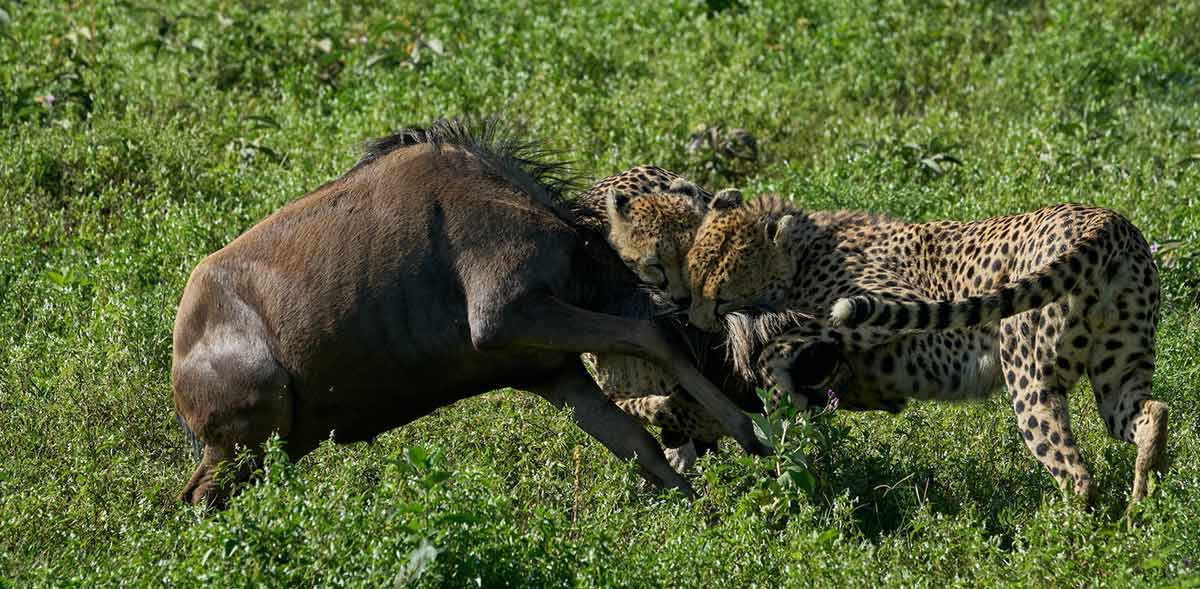
However, this abundance of new life also attracts predators. Lions, cheetahs, spotted hyenas, and other carnivores may hunt around the herds, making the southern Serengeti one of the most compelling places to observe predator-prey interactions.
What makes the calving season special?
Newborn wildebeest: Watch young calves develop the strength and coordination needed to follow their mothers and remain with the herd.
Maternal behaviour: Observe mothers protecting, nursing, and guiding their young across the plains.
Predator activity: The concentration of prey can attract predators, offering opportunities to observe hunting behaviour and interactions between species.
Large concentrations of wildlife: Depending on seasonal conditions, vast herds of wildebeest and zebras may gather across the southern plains.
Green-season photography: The landscapes can be lush and colourful, creating beautiful contrasts between the grasslands, animals and dramatic skies.
The calving season offers a more intimate perspective on the Great Wildebeest Migration. Instead of focusing primarily on a dangerous river crossing, you spend time observing the relationships and behaviours that sustain the migrating population.
For travellers who appreciate wildlife photography, animal behaviour and the quieter details of the natural world, this can be an exceptionally rewarding safari.
Where should you visit during calving season?
The main areas to consider are:
Ndutu: Particularly well known for seasonal concentrations of wildebeest and newborn calves.
Southern Serengeti: Offers access to the wider short-grass plains used by migratory herds.
Central Serengeti: Can be incorporated into a broader itinerary, particularly for resident wildlife and big-cat viewing.
Similarly, your accommodation should be selected according to the expected location of the herds, your travel dates, and the style of safari you prefer.
Explore our Ndutu Calving Season Safari Guide for a more detailed look at the region and itinerary options.
What Is the Serengeti Mara River Crossing Season
River crossing season is another dramatic chapter in the Great Wildebeest Migration. It occurs as migratory herds move through the western and northern parts of the Serengeti ecosystem in search of suitable grazing.
Two rivers are especially important when planning a migration safari in Tanzania: the Grumeti River in the western Serengeti and the Mara River in the north. Although both can feature migration crossings, they are different experiences and should not be confused.
The Grumeti River crossings
The Grumeti River lies in the western Serengeti. Depending on the movement of the herds, possible crossings may occur as the migration moves through the Western Corridor, often around May to July.
This region offers a combination of grasslands, woodland and riverine habitats. The river is home to Nile crocodiles and hippos, while the surrounding landscape supports a variety of resident wildlife.
This is ideal for visitors who want to follow the migration; the Western Corridor can provide an opportunity to observe herds moving through the ecosystem and, with favourable timing, attempting Mara River crossings. However, crossings are not scheduled events. Their occurrence depends on herd movements, river conditions and the animals’ behaviour.
The Mara River crossings
The Mara River is the better-known destination for travellers hoping to witness the iconic wildebeest river crossings. This happens in the northern Serengeti, particularly around Kogatende and the Lamai area, where large herds gather near the Mara River before attempting to cross. The river forms part of the wider ecosystem shared by Tanzania and Kenya, and the migrating animals may move between the northern Serengeti and Kenya’s Maasai Mara.
A crossing can unfold rapidly or involve long periods of waiting. Wildebeest can gather along the bank, move towards the water and retreat several times before finally entering the river, and when a crossing begins, animals must negotiate strong currents, steep banks and the presence of crocodiles. Some cross successfully, while others may be injured or lost. This uncertainty is a defining feature of the experience. There is no timetable that tells a guide exactly when a crossing will begin.
Why choose a river crossing safari
A river crossing safari is especially appealing if you want to experience:
- Large herds moving together across the northern Serengeti.
- Wildebeest gathering at riverbanks before attempting to cross.
- Zebra and wildebeest moving through the same migration corridors.
- The dramatic interaction between migratory animals and their environment.
- Riverine wildlife, including crocodiles and hippos.
- Opportunities to photograph the movement and scale of the Great Wildebeest Migration.
The key consideration is patience. Even during the recognised crossing season, you may spend hours observing the herds before a crossing happens. Some visits may not include a crossing at all, but a well-planned safari focuses on the overall migration experience rather than promising a particular moment.
Serengeti Calving Season vs River Crossing Season: Which Offers Better Predator Viewing?
Both seasons can provide excellent predator viewing, but the setting and behaviors you may observe are different.
Predators during the calving season
During calving season, large concentrations of newborn wildebeest create opportunities for predators to hunt vulnerable prey. Lions may patrol the plains or rest near areas frequented by the herds. Cheetahs can take advantage of open terrain when pursuing prey, while spotted hyenas may hunt or scavenge.
For wildlife enthusiasts, the calving season provides opportunities to observe the relationship between prey availability, predator behaviour, and the challenges faced by newborn animals.
The experience is not limited to dramatic hunts. You may also observe lions resting, mothers leading calves through the grass, and herds responding to nearby predators.
Predators during the Mara River crossing season
During the river crossing period, predators may follow the migrating herds through the northern Serengeti. Lions, leopards, cheetahs, and hyenas remain important parts of this spectacle, although their visibility depends on location and local conditions.
At the Mara River, Nile crocodiles are a major feature of the crossing environment. They may wait in the water near areas used by migrating animals.
However, crocodile attacks are not guaranteed, and not every crossing results in a dramatic predator encounter. The spectacle is often as much about the hesitation, movement and collective behaviour of the herds as it is about predation.
Which season should you choose for a wildlife photographer?
Both seasons can produce outstanding images. The best choice depends on the subject you want to photograph, the weather, and the movement of the animals.
The guide on the Best Time to Visit the Serengeti for Calving Season
The calving season is commonly associated with the period from December to March, with January and February often popular months for seeing newborn wildebeest.
The precise timing depends on rainfall and the availability of fresh grazing across the southern plains.
December: The herds gather in the south
December can be a rewarding time to visit as migratory herds gather across parts of the southern Serengeti and Ndutu area. The concentration of newborn calves may still be developing, depending on the season.
January: The calving season becomes a major attraction
January is a popular month for travellers hoping to see newborn wildebeest. Large herds may gather on the southern plains, and game drives can provide opportunities to observe calves and predator activity.
February: A key month for newborn calves
February is often considered one of the strongest months for calving season safaris. The southern plains may support large concentrations of wildebeest, although the location and density of the herds can vary.
March: Wildlife viewing continues
Calving activity may continue into March, but seasonal conditions and herd movements can change. A flexible itinerary helps you make the most of the available wildlife-viewing opportunities.
Expert recommendation on Serengeti Calving vs Mara River Crossing. If seeing newborn wildebeest is your priority, plan several nights in Ndutu or the southern Serengeti rather than trying to fit the experience into a single day.
The Guide on the Best Time to Visit the Serengeti for Mara River Crossings
The best-known Mara River crossing season generally falls between July and October. However, crossings may begin earlier or continue later depending on rainfall, herd movements and local conditions.
June: Consider the Western Corridor
In June, migration activity may be concentrated in the western Serengeti, where herds move through the Western Corridor towards the Grumeti River. This period can be attractive for travellers seeking migration activity outside the busiest northern-season window.
July: The northern migration develops
By July, parts of the migration may reach the northern Serengeti, and Mara River crossings can begin. The exact timing varies each year, so travellers should not assume that the herds will be at a particular crossing point on a specific date.
August: A popular month for river crossing safaris
August is a highly requested month for northern Serengeti safaris. Herds may gather around the Mara River, offering opportunities to observe crossing behaviour when conditions align.
September: Continue exploring the northern Serengeti
September can also be rewarding for migration viewing. The herds may move between different parts of the northern Serengeti and the Maasai Mara, and the timing of crossings remains unpredictable.
October: Later crossings may occur
Crossing activity may continue into October, although herd distribution can change as seasonal rainfall influences movement back towards southern grazing grounds.
Our recommendation: For a river crossing safari, choose accommodation in the northern Serengeti based on the expected location of the herds, and allow enough days for wildlife movements to unfold naturally.
The Season with Better Weather and Scenery
Weather can influence your safari experience, but neither season should be selected on weather alone.
Calving season scenery
The southern Serengeti often has greener landscapes during the calving season because of seasonal rainfall. Fresh grass, open plains, and dramatic skies can create beautiful conditions for photography.
Rain is possible, and roads can become muddy in some areas. However, showers do not automatically prevent good wildlife viewing.
The green landscapes also provide a different visual experience from the drier plains seen later in the year.
River crossing season scenery
The northern Serengeti is often drier during the main river crossing period. Grass may be shorter in some areas, and wildlife can be easier to observe against the landscape.
The Mara River adds a distinctive element to the scenery, with wooded banks, rocky sections and riverine vegetation contrasting with the surrounding grasslands.
Dry-season conditions can be favorable for game drives, but dust and temperature variations are also possible.
Which is better for photography?
Calving season often appeals to photographers who enjoy green landscapes, newborn animals, and intimate wildlife behaviour.
River crossing season is especially attractive to photographers seeking dramatic action and large herds against a river backdrop.
Both seasons have their own visual character, and neither guarantees a particular photograph.
Which Season Is Better for a Luxury Serengeti Safari?
A luxury safari is not defined only by the standard of accommodation. It is also shaped by where you stay, how much time you spend in the field and how closely your itinerary follows your interests.
Luxury during calving season
A well-positioned camp in or near Ndutu can offer convenient access to the southern plains during the main calving period.
Depending on your chosen accommodation, your safari may include:
- Comfortable tented suites or luxury lodge accommodation.
- Private game drives with an experienced guide.
- Flexible departures to suit wildlife activity.
- Time for photography and extended wildlife observation.
- Carefully planned transfers between safari areas.
Luxury during river crossing season
For a river crossing safari, consider accommodation in the northern Serengeti, particularly around Kogatende or the Lamai area, according to your travel dates and the expected distribution of the herds.
A well-positioned camp can make it easier to spend time exploring the northern migration area and responding to changing wildlife movements.
A luxury itinerary may include:
- High-quality tented camps or lodges.
- Private guiding arrangements.
- Flexible game drives.
- Scenic flights between safari destinations where available.
Additional time in the Serengeti to allow for unpredictable crossings.
River crossings are not guaranteed, even when you stay close to the Mara River. The value of a well-designed safari is the opportunity to explore the region properly, not a promise that a crossing will occur.
Which Season Is Better for Families?
Families can enjoy both seasons, but the best choice depends on the ages and interests of the travelers.
Family safari during calving season
Calving season can be especially engaging for families interested in animal behavior and the early stages of wildlife development.
Children may enjoy seeing newborn calves, zebras and large herds across the plains. Guides can explain how animals care for their young, why wildebeest migrate and how predators fit into the ecosystem.
Family safari during mara river crossing season
River crossing safaris can be exciting for older children and teenagers interested in wildlife documentaries, migration and animal behavior.
However, long waits for a crossing may be challenging for younger children. The experience requires patience because herds can gather at the river and remain there without crossing.
Families should choose accommodation and activities according to the ages of their children, the length of the journey and the flexibility of their safari schedule.
How Many Days Do You Need for Each Experience?
The duration of your safari affects how much time you have to explore the landscape and respond to wildlife movements.
Recommended duration for Serengeti calving season safari
A stay of around three to five nights in the southern Serengeti or Ndutu area can provide a rewarding calving season experience.
This allows time for several game drives, exploration of different habitats, and opportunities to observe the herds as they move across the plains.
You can also combine the southern Serengeti with other destinations, such as the Ngorongoro Crater or central Serengeti.
Recommended duration for Mara River crossing season
For a migration-focused river crossing safari, consider spending around three to five nights in the northern Serengeti, depending on your budget and overall itinerary.
Additional nights provide more flexibility to explore different areas and wait for possible crossings. They do not guarantee that a crossing will occur.
If you have enough time, combining the northern Serengeti with the central Serengeti or Ngorongoro Conservation Area can add variety to your trip.
These are planning recommendations rather than fixed minimums. Your ideal duration depends on travel time, flight connections, accommodation, and the wildlife experience you want.
Is it possible to Experience Both Calving Season and River Crossing Season on One Safari?
Seeing both the calving season and the main Mara River crossing season usually requires two separate visits or a much longer journey timed across different months. The two experiences typically occur several months apart. Calving season is associated with the southern Serengeti and Ndutu area from approximately December to March, while the main Mara River crossing period is usually July to October.
Trying to see both within a short trip is therefore not practical.
However, you can experience the broader Great Wildebeest Migration at different stages of the annual cycle.
Option 1: Calving season and Ngorongoro Crater
Spend several nights in central Serengeti, then go to the Ndutu or the southern Serengeti for your dream calving experience, then continue to the Ngorongoro Conservation Area for explosive game viewing. This combination is ideal for travelers who want to focus on newborn wildebeest while also exploring one of Tanzania’s most celebrated wildlife destinations.
Option 2: Northern Serengeti and central Serengeti
Plan a migration safari around the northern Serengeti during the river crossing season, then explore the central Serengeti for its resident wildlife and predator viewing. This combination offers variety while keeping the focus on the northern migration.
Option 3: Two separate Tanzania safari journeys
If witnessing both events is a long-term travel goal, consider visiting Tanzania once during calving season and returning later in the year for river crossing season.
This allows each safari to focus on the appropriate region and season instead of rushing between destinations.
Our safari experts at Gorilla Hour Uganda will help design an itinerary around your dates, interests, and preferred level of comfort.
Which Season Is More Expensive?
The cost of a Serengeti safari depends on accommodation, travel dates, park fees, transport, the number of nights, and the size of the group.
Neither season has one fixed price.
Calving season costs
Prices vary according to camp category and availability. Luxury camps in prime southern Serengeti National Park and Ndutu locations may command premium rates during popular travel periods.
The green season can offer different pricing opportunities at some properties, but travelers should not assume that calving season is automatically inexpensive. Demand for well-positioned camps can be high.
River crossing season costs
The northern Serengeti is popular during the main river crossing period. Camps in prime locations may be in high demand, particularly during July, August and September.
Private guiding, fly-in arrangements and accommodation close to migration areas can increase the total cost.
Serengeti Calving Season vs Mara River Crossing Season: expert Recommendation
There is no universal winner between the Serengeti calving season and river crossing season. Each reveals a different part of the Great Wildebeest Migration.
Choose the calving season if you want to:
- See newborn wildebeest and their mothers.
- Observe early-life behavior and maternal care.
- Explore the southern Serengeti and Ndutu plains.
- Photograph green landscapes and large concentrations of wildlife.
- Observe predator-prey interactions around the calving herds.
Choose the mara river crossing season if you want to:
- Explore the northern Serengeti during the main migration period.
- Watch large herds gather near the Mara River.
- Photograph the movement of wildebeest and zebras.
- Experience the tension and uncertainty surrounding possible crossings.
- Focus your safari on the northern migration landscapes.
If you are travelling for the first time and have a strong preference for one of these experiences, let that preference guide your dates and accommodation.
If you are more interested in wildlife as a whole than in one specific event, the Serengeti national parks offer rewarding game viewing throughout the year. The best itinerary depends on which regions are most suitable for your travel dates.
Plan Your Serengeti Migration Safari with Gorilla Hour Uganda
The Great Wildebeest Migration is not a single event that takes place in one location. It is a continuous cycle shaped by rainfall, fresh grazing, reproduction and the movement of enormous herds across the Serengeti–Mara ecosystem.
During calving season, the southern plains become a nursery for newborn wildebeest. Months later, migrating herds may gather along the Mara River, where crossing attempts reveal another side of their extraordinary journey.
Both experiences offer memorable wildlife encounters, but the most rewarding safari begins with choosing the right region for the right season.
At Gorilla Hour Uganda, we help visitors like you plan bespoke Tanzania safaris that reflect your priorities, whether that means a luxury calving season experience in Ndutu, a migration-focused journey to the northern Serengeti, or a combined East Africa safaris.
Tell us when you want to travel and what you hope to see. We will help you build a Serengeti safari around your interests, available time, and budget.
Request your bespoke Serengeti Migration Safari with Gorilla Hour Uganda.


