


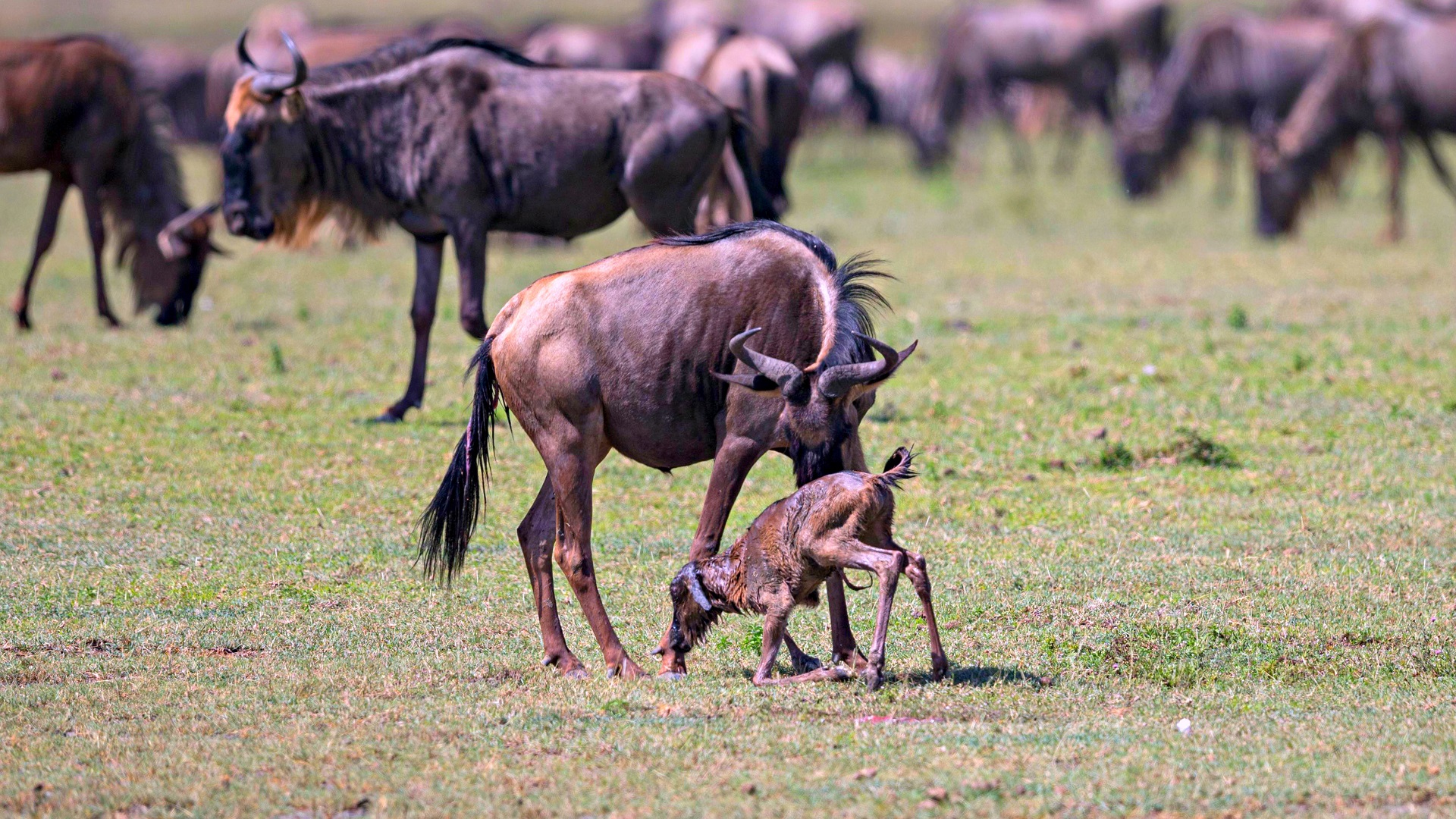
What Is the Serengeti Calving Season?
The Serengeti calving season is the period when large numbers of wildebeest give birth across the southern Serengeti ecosystem, particularly around the Ndutu plains and neighbouring grasslands. It is one of the most fascinating stages of the Great Wildebeest Migration, an annual movement involving enormous herds of wildebeest, accompanied by zebras and other grazing animals, as they move across the Serengeti ecosystem in response to rainfall, fresh grass and water availability.
Unlike a conventional wildlife safari, where sightings may be spread across different habitats, a well-timed calving season safari can place you in a landscape supporting exceptionally high concentrations of wildlife.
The southern plains provide nutritious grazing that supports pregnant wildebeest and their newborn calves. Following seasonal rains, the short grass becomes particularly valuable to the herds, helping females meet the energy demands of late pregnancy and lactation.
For several weeks, the landscape becomes a vast nursery.
Wildebeest calves are born in large numbers, and the newborns face their first challenges almost immediately. They must stand, begin walking and keep close to their mothers, all while sharing the plains with predators that depend on the seasonal abundance of prey.
Lions, cheetahs, spotted hyenas and other carnivores take advantage of this concentration of wildlife. Their presence creates opportunities to observe natural behaviour predators hunting, feasting on their prey, although these sightings and hunting encounters are not a guarantee.
What makes the Serengeti calving season safari exceptional is not simply the number of animals. It is the opportunity to witness wildebeest annual cycle.
You may watch a mother encouraging her calf to stand, observe a herd moving across the plains in a cloud of dust, or observe as your guide interpreting the behaviour of predators resting near the grazing animals. These are the moments that give a Serengeti calving season safari its lasting appeal.
Why Is the Calving Season Important to the Great Migration?
The Great Wildebeest Migration is not a single event that takes place on one particular day. It is a continuous movement of animals through the Serengeti ecosystem and, later in the year, into Kenya’s Maasai Mara.
Rainfall, pasture quality and water availability influence the herds’ movements. Consequently, their precise locations can vary from one year to another.
Its important to note that the calving is an essential part of this annual cycle. By gathering in areas with nutritious grazing, wildebeest females can give birth in conditions that support the early development of their calves. The abundance of young animals also creates a seasonal food source for predators.
This concentration of wildlife makes the southern Serengeti especially rewarding during the calving period, which we highly recommend to our visitors.
When Is the Serengeti Calving Season?
The Serengeti calving season generally takes place between December and March, with January and February often providing particularly rewarding opportunities to witness newborn wildebeest and associated predator activity. The most productive period for your safari depends on rainfall, the location of the herds and the condition of the grazing grounds.
For this reason, we recommend planning around the expected seasonal pattern while remaining flexible enough to accommodate changing wildlife movements.
Serengeti Calving Season in December
December marks the beginning of the main calving-season travel window for many visitors. Following seasonal rainfall, herds often move towards the southern Serengeti and Ndutu area, where fresh grazing becomes available. As the landscape changes, the number of wildebeest in the region can increase significantly. December is particularly appealing to visitors who want to experience the southern Serengeti as the seasonal wildlife concentration develops.
During your safari, you may encounter large herds, zebras grazing alongside wildebeest, and predators moving through the grasslands. The landscape can also be beautifully green after rain, creating attractive conditions for wildlife photography.
However, December is a transitional period, and the precise concentration of animals depends on the timing and distribution of rainfall.
Best for: Travellers seeking the beginning of the calving-season experience, green landscapes and a safari that may combine well with a festive-season holiday.
Serengeti Calving Season in January
January is often one of the most attractive months for a Serengeti calving season safari. By this stage, substantial numbers of wildebeest may be concentrated around Ndutu and the southern plains, although conditions vary from year to year.
The open grasslands offer opportunities to observe herds at close range, while newborn calves become an increasingly important part of the wildlife experience.
Predators are also active in the region. Lions may be seen resting near the herds, while cheetahs use the open terrain to scan for opportunities. Spotted hyenas may patrol the same areas, taking advantage of the abundance of prey.
For photographers, January can provide excellent opportunities to capture herd movements, mother-and-calf interactions, and wildlife against the broad southern Serengeti landscape.
The expertise of our guide will help interpret what is happening around you and identify promising areas to explore during your game drive.
Best for: Wildlife enthusiasts, photographers and travellers who want to experience the calving season while the southern plains support large concentrations of wildlife.
Serengeti Calving Season safari in February
February is widely regarded as one of the prime months for experiencing the wildebeest calving season. Large numbers of calves may be born across the Ndutu and southern Serengeti grasslands, creating a remarkable concentration of newborn wildlife.
For visitors, this can mean opportunities to observe calves staying close to their mothers, herds moving across the plains and predators navigating an ecosystem rich in prey.
The experience is not limited to dramatic encounters. Much of the fascination lies in quieter observations: a mother grooming her calf, young wildebeest finding their footing or a herd gathering after moving across the grasslands.
The open terrain can also be rewarding for photography because it often allows clearer views of animals than more densely vegetated habitats. Nevertheless, wildlife encounters remain unpredictable. The best experience comes from allowing enough time for unhurried game drives instead of trying to fit every sighting into a rigid schedule.
We recommend considering several nights in the southern Serengeti or Ndutu when your main objective is the calving season. This provides more flexibility to follow wildlife movements and enjoy different parts of the ecosystem.
Best for: Travelers prioritizing newborn wildebeest, predator activity, wildlife photography, and the classic southern Serengeti calving-season experience.
Serengeti Calving Season safari in March
March can continue to offer rewarding wildlife experiences, although the distribution of the herds and the timing of their movements depend on seasonal conditions.
Some areas may still support substantial concentrations of wildebeest and young calves, while other herds may begin moving towards different grazing grounds as conditions change.
March may appeal to travellers seeking a quieter or more flexible safari experience, but it is important not to assume that every part of the southern plains will retain the same wildlife concentration throughout the month.
Our well-planned itineraries take account of prevailing conditions and the locations most likely to provide rewarding game drives.
Best for: Travellers with flexible dates who want to explore the southern Serengeti during the later part of the main calving-season window.
Which Month Should You Choose?
If witnessing newborn wildebeest is your primary objective, January and February are excellent starting points for planning.
December can be attractive as the herds gather in the south, while March can still provide worthwhile sightings depending on rainfall and migration movements.
Our advice is to choose your travel dates first, then plan your route and accommodation around the expected location of the herds.
Understanding The Annual Great Wildebeest Migration Cycle: How Calving Connects the Serengeti and Maasai Mara
To understand the Serengeti calving season safari, look beyond January, February, and March.
The Great Wildebeest Migration is not a single event that begins when the calves are born and ends when the herds leave Ndutu. It is a continuous, rainfall-driven movement across the Greater Serengeti–Mara ecosystem.
The migratory herds move between Tanzania and Kenya in response to fresh grazing, water availability, and changing seasonal conditions.
The southern plains provide important wet-season grazing and calving grounds. As the landscape dries, the herds gradually move west and north before returning towards the southern Serengeti as the next rainy season approaches.
The journey is a continuous ecological cycle rather than a fixed route followed on exact dates.
November–December: The Return Towards the Southern Plains
The migration begins its southern movement as seasonal rains develop in parts of the Serengeti National Park.
Following the dry season in the north, wildebeest move through the eastern and central Serengeti towards the southern grasslands. The fresh rainfall encourages new vegetation growth, providing increasingly attractive grazing conditions. During this period, the herds begin gathering around the southern Serengeti and Ndutu region, where visitors can experience the Serengeti calving season safari or the Ndutu calving season safari. Their distribution depends on where the rain has fallen and where suitable grass is available.
December can be an excellent month when planning a calving safari following the migration towards the southern plains, although the precise arrival of large herds varies each year.
January–March: The Great Wildebeest Calving Season
This is the period when the southern Serengeti becomes one of the most important wildlife destinations in East Africa, and visitors start to enjoy the Serengeti Calving season safari and the Ndutu calving season safari. Large herds gather across the short-grass plains, including the Ndutu area and the surrounding southern ecosystem. The grass provides valuable nutrition for pregnant females and lactating mothers. The seasonal concentration of animals creates the conditions for a major reproductive event.
February is generally regarded as the peak calving month, although births take place over a broader period. The southern plains become a nursery for newborn wildebeest, while predators follow the large concentration of potential prey.
For wildlife photographers, this period offers opportunities to observe maternal behaviour, newborn calves, predator activity and large migratory herds.
April–May: The Herds Begin Moving West
As the long rains progress and grazing conditions change, the herds gradually begin leaving the southern plains. Many move towards the central and western Serengeti, following fresh vegetation.
This is also a period when the landscape can become especially attractive for photography. The grasslands are greener, the skies can be dramatic, and wildlife is distributed across different sections of the ecosystem.
The migration does not leave all areas at once. Some groups may remain in the south while others move farther west. April and May can offer rewarding safari experiences, although heavy rainfall may affect road conditions and some seasonal camps.
June–July: The Western Corridor and Grumeti River
By the middle of the year, large sections of the migration move towards the Western Corridor of Serengeti National Park.
The Grumeti River becomes an important geographical feature along this route. Some herds encounter river crossings as they move through the region. Crocodiles inhabit sections of the river, and the crossing points can create dramatic wildlife scenes.
However, not every animal crosses at the same location or on the same day. Some herds may cross relatively quickly, while others remain nearby before finding a suitable crossing point. This is a period worth considering for travellers interested in the western Serengeti and its seasonal wildlife activity.
July–October: Northern Serengeti and the Mara River
As the dry season progresses, the migration continues towards the northern Serengeti and the Maasai Mara in Kenya.
The Mara River becomes one of the best-known features of this phase. River crossings can be spectacular, with large numbers of wildebeest gathering along the banks before entering the water. Crocodiles, steep banks and strong currents make some crossings particularly challenging. The crossings are unpredictable. Herds may gather for hours or days before moving, and some may cross at different points.
This is why we always advise travellers not to plan a safari around a guaranteed river crossing. Instead, allow enough time in the northern Serengeti to follow the herds and appreciate the wider wildlife experience.
October–November: The Migration Turns South Again
As the northern plains become drier and seasonal rainfall begins developing farther south, the herds gradually start moving towards the Serengeti’s central and eastern regions.
The migration begins its return towards the southern grazing grounds. The timing and route depend on rainfall distribution, meaning some herds may move south earlier while others remain in the northern ecosystem.
This brings the migration towards another wet season and another calving period.
Where Does the Serengeti Calving Season Take Place?
Although the Great Wildebeest Migration covers a vast area, the southern Serengeti ecosystem is the principal focus for travellers hoping to experience the calving season. Three areas deserve particular attention: Ndutu, the southern Serengeti plains and the wider Serengeti National Park.
Ndutu: The Heart of the Calving Season
Ndutu is one of the best-known locations for experiencing the Serengeti calving season. Situated within the wider southern Serengeti National park, the Ndutu area encompasses open grasslands, seasonal water sources, woodland and habitats that support a wide variety of wildlife.
During the calving period, these landscapes can attract large concentrations of wildebeest, zebras and predators. The combination of open plains and varied habitats makes Ndutu particularly rewarding for game drives. You can explore different sections of the ecosystem, searching for grazing herds, observing predator behaviour and watching the changing activity of the landscape throughout the day.
Ndutu is especially popular with wildlife photographers because the open grasslands can provide excellent sightlines and opportunities to photograph animals in their natural environment.
It is also an excellent base for travellers who want their itinerary to focus primarily on calving-season wildlife rather than dividing their time between too many destinations.
What Makes Ndutu Special?
Large concentrations of wildebeest: During favourable conditions, enormous herds gather across the surrounding plains.
Newborn calves: The calving period creates opportunities to observe young wildebeest alongside their mothers.
Predator activity: Lions, cheetahs and spotted hyenas may be encountered in areas supporting abundant prey.
Photography opportunities: The open terrain can provide attractive backgrounds, natural light and opportunities to observe animal behaviour.
A varied landscape: Beyond the grasslands, the area includes woodland and seasonal water sources that support different wildlife encounters.
When choosing accommodation, consider how much time you want to spend exploring the area, whether you prefer a permanent lodge or a seasonal tented camp, and how easily your chosen property can access suitable game-driving areas.
Explore our Ndutu Calving Season Safari Guide for a more detailed destination overview.
The Southern Serengeti Plains
The southern Serengeti plains form a broader wildlife landscape extending beyond the immediate Ndutu area. These plains are particularly important when seasonal rainfall produces nutritious grazing that attracts migrating wildebeest.
the southern plains offer the classic Serengeti experience which comprise the vast horizons, enormous herds, scattered acacia trees and the possibility of encountering predators in open terrain. The location of the herds can change within the season, so it is worth discussing your intended travel dates with your safari specialist when choosing where to stay.
Serengeti National Park
Serengeti National Park protects an extraordinary range of habitats and supports wildlife throughout the year. Although the southern plains and Ndutu are especially important during the calving season, the wider park remains relevant to travellers planning a longer Tanzania safari. We highly recommend combing these locations with the central serengeti which is rich in animals all year round, regardless of the season of travel, central sector never disappoints.
Should You Stay in Ndutu or the Central Serengeti?
The answer depends on your travel dates and priorities.
If witnessing the calving season is the main reason for your trip, accommodation in or near Ndutu and the southern plains can be a practical choice during the appropriate months.
The central Serengeti, meanwhile, can work well for travellers interested in a broader wildlife itinerary or combining different areas of the park.
Neither option is automatically superior in every circumstance. What matters is matching the your intended wildlife experience, the the right season and accommodation.
What Wildlife Can You See During Serengeti Calving Season?
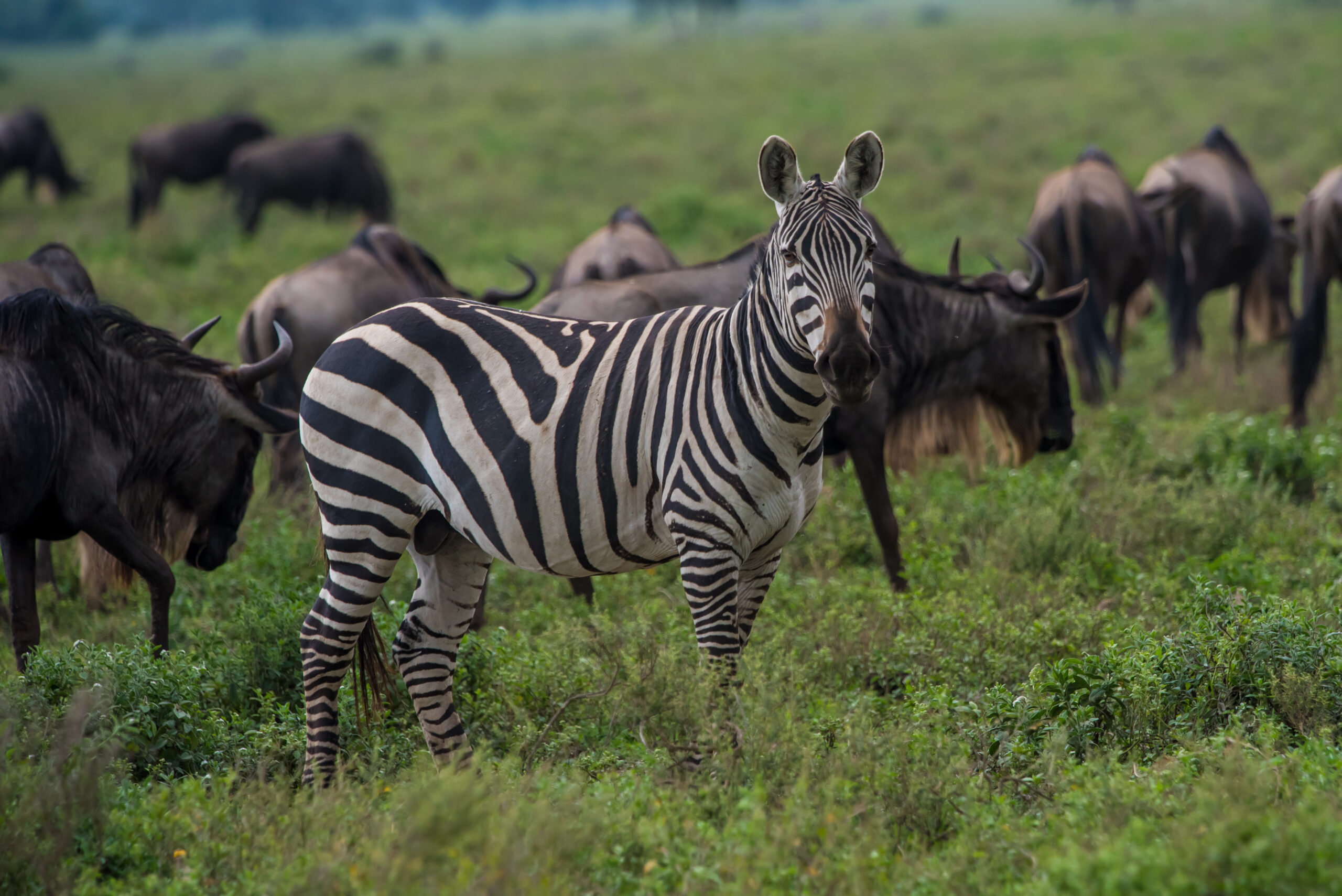
The wildebeest are the central attraction, but they are only part of the story.
The southern Serengeti ecosystem supports a rich variety of mammals and birdlife, and the concentration of grazing animals during the calving season can create rewarding wildlife-viewing opportunities.
Wildebeest: The Stars of the Season
The wildebeest are the reason many travelers choose this particular safari.
Watching a large herd move across the plains is an impressive experience in itself. The animals move in shifting groups, with individuals responding to the movements of those around them.
During calving season, the presence of newborns adds another dimension.
You may observe mothers keeping their calves close, young animals attempting to follow the herd and groups gathering before moving across the grasslands.
Wildebeest calves are capable of standing and moving soon after birth, an important adaptation in an ecosystem where predators are present.
Their early days are nevertheless challenging. Staying close to the herd and keeping up with their mothers are essential to their survival.
A knowledgeable guide can help you recognize these behaviors and understand why the calving season is so important to the wider migration.
Zebras: Travelling Alongside the Herds
Zebras are frequently associated with the Great Migration and may be encountered grazing alongside wildebeest.
Although both species depend on suitable grazing, their feeding preferences differ, allowing them to use grassland resources in complementary ways.
Zebras add variety to wildlife sightings and provide striking photographic subjects against the open plains.
Their presence also reinforces an important point: the Great Migration is not solely about wildebeest. It is part of a much larger ecological process involving several species and the habitats they depend on.
Lions: Powerful Predators of the Plains
Lions are among the most sought-after animals on a Serengeti safari.
During calving season, the abundance of prey can create favorable hunting opportunities for lions living in or visiting the southern plains.
You may encounter lions resting beneath trees, moving through grassland or observing nearby herds.
Sometimes, a sighting involves little visible activity. A lion may simply lie in the shade while wildebeest graze in the distance.
Yet these quiet moments can be just as informative as a dramatic encounter. With an experienced guide, you can learn to interpret posture, movement, group behavior and the relationship between predators and prey. Actual hunts are unpredictable, and responsible wildlife viewing means observing animals without disturbing them.
Cheetahs: Speed Across Open Grasslands
Cheetahs are particularly fascinating to watch in the open southern Serengeti.
Their hunting strategy relies on spotting prey, assessing opportunities and using extraordinary speed over short distances.
The open terrain can make it easier to observe their behavior, although sightings are never guaranteed.
During calving season, the abundance of young wildebeest may create hunting opportunities for cheetahs, but the outcome of any encounter depends on natural conditions.
For photographers, a cheetah scanning the plains from a termite mound or moving through golden grass can be a memorable sight even without a hunt.
Spotted Hyenas: Essential Members of the Ecosystem
Spotted hyenas are highly adaptable carnivores that play an important role in the Serengeti ecosystem.
They hunt, scavenge and interact with other predators, contributing to the natural processes through which energy moves through the food web.
During calving season, their presence becomes particularly noticeable in areas supporting large concentrations of prey. Observing hyenas can reveal a great deal about the complexity of the ecosystem, including competition between predators and the behavior of animals responding to changing opportunities.
Leopards and Other Wildlife
Leopards may be encountered in suitable habitats, particularly around woodland and areas with substantial tree cover.
Their solitary behavior and camouflage can make them more difficult to locate than some other large mammals.
The wider region also supports giraffes, elephants, gazelles, jackals, warthogs and numerous bird species, although the animals you encounter will depend on the precise area visited.
A calving-season safari is therefore not a single-species experience. It offers an opportunity to explore a living ecosystem in which different animals respond to the same seasonal changes in different ways.
Why Do So Many Wildebeest Give Birth at Around the Same Time?
One of the most remarkable features of the Great Migration is the concentration of births within a relatively short period. Wildebeest have evolved reproductive patterns that help their young enter the world when environmental conditions are favorable.
The timing of the calving season is closely connected to the availability of nutritious grazing, which helps pregnant females maintain their condition and supports milk production after birth.
Giving birth when large numbers of other calves are also present may help reduce the risk faced by any individual calf. Predators can take advantage of the abundance of prey, but the scale of the herds means they cannot capture every newborn.
This does not make the early days easy for the calves. Many face serious threats, and survival depends on a combination of maternal care, herd behavior, physical development and environmental conditions.
For visitors, this is part of what makes the calving season so compelling.
You are not simply watching animals gather on a plain. You are witnessing a crucial stage in the life cycle of one of Africa’s most famous migrating mammals.
How Many Wildebeest Calves Are Born During the Calving Season?
Large numbers of wildebeest calves are born during the main calving period, with commonly cited estimates reaching several hundred thousand across the wider migration population.
Exact figures vary according to the population estimate, the season and the geographical area being considered. It is therefore more useful to understand the scale of the event than to treat a single number as guaranteed for every year.
During a productive season, the concentration of births can be extraordinary, transforming the southern grasslands into a vast nursery.
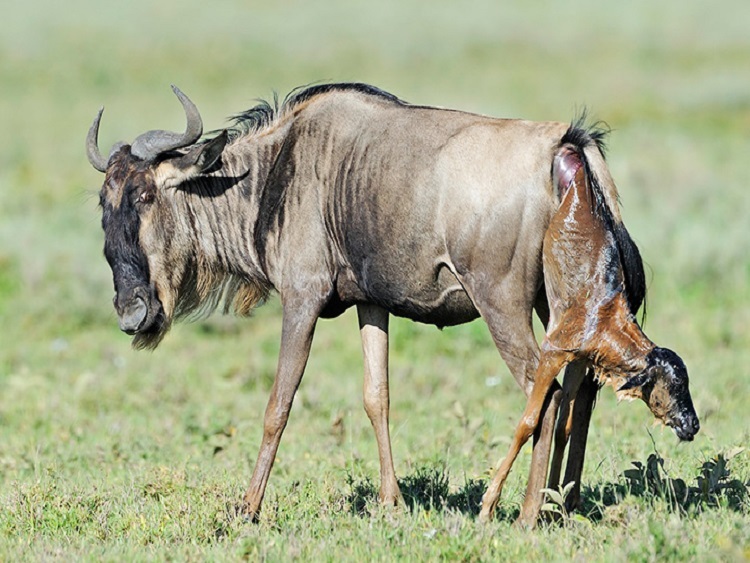
The First 24 Hours of a Wildebeest Calf’s Life
One of the most remarkable events during the Serengeti calving season happens on the ground, often unnoticed by travelers watching the enormous herds from a safari vehicle. It is the arrival of a newborn wildebeest calf.
Unlike some other grazing mammals whose newborns remain hidden for extended periods, wildebeest calves are born with an extraordinary ability to move almost immediately. Their survival depends on developing strength and coordination quickly because the open plains offer very little protection from predators. For a visitor like you, witnessing a wildebeest birth and watching the calf take its first steps is one of the most intimate experiences the Serengeti can offer.
The first 24 hours are particularly important. During this short period, a newborn must establish a bond with its mother, begin nursing, develop the ability to follow the herd, and become mobile enough to escape danger.
Birth on the Open Plains
Wildebeest births take place across the southern Serengeti and surrounding calving grounds, particularly on the short-grass plains around Ndutu. Female wildebeest generally give birth to a single calf. The newborn enters a landscape that may contain thousands of other animals, with predators such as lions, cheetahs, spotted hyenas and jackals searching for vulnerable prey.
The mother usually separates herself sufficiently from nearby animals to give birth, although the exact circumstances vary. The calf arrives with a coat that is lighter and browner than the darker appearance of mature wildebeest.
The birth itself is only the beginning. The challenge is to become mobile before the surrounding dangers become an immediate threat.
The First Few Minutes: Learning to Stand
A newborn wildebeest does not have the luxury of spending hours resting after birth. Within minutes, it begins attempting to lift its head, gather its legs beneath its body, and stand. These early attempts can be unstable. The calf may rise, stumble and fall before gradually finding its balance. Research on wildebeest development describes calves standing remarkably quickly, sometimes within approximately six to seven minutes.
This early mobility is one of the species’ most important survival adaptations. Unlike a young animal that relies on remaining concealed, a wildebeest calf must develop the ability to move with its mother and the herd. Its chances of survival depend heavily on this rapid physical development.
The First Hour: Recognising and Following Its Mother
Once the calf can stand, its next challenge is to identify and remain close to its mother. This early bonding process is critical. The calf needs its mother’s milk, protection, and guidance, while the mother must recognize and maintain contact with her newborn in a landscape filled with other animals.
Wildebeest calves are known as follower young because they can accompany their mothers shortly after birth. Within the first hour, a healthy calf may already be attempting to follow its mother. Its movement may initially be unsteady, but its coordination improves rapidly.
This is particularly important during the calving season because the herds are constantly moving across the plains in search of suitable grazing.
Nursing and Receiving Essential Nutrition
The first nursing period is another important milestone. The calf needs to obtain its mother’s milk, which supplies energy, nutrients, and antibodies through colostrum, the first milk produced after birth. This early nutrition supports the newborn’s immune system and helps it adapt to life outside the womb.
The mother-calf relationship becomes particularly important during the following weeks and months, when the calf depends on regular nursing and maternal care while developing its strength.
The First Few Hours: Building Coordination and Speed
By the time several hours have passed, the calf is generally much more coordinated than it was immediately after birth.
It begins following its mother more confidently and can move alongside other wildebeest.
Although its movements may still appear awkward, the young animal is developing the ability to run when threatened.
This is an extraordinary adaptation. The southern Serengeti is an open environment, and predators can approach from considerable distances. A calf that cannot keep up with its mother is particularly vulnerable.
Joining the Herd: Safety in Numbers
As the mother and calf move back towards other wildebeest, the newborn becomes part of a much larger social group.
During the calving season, there are large aggregations of females and young animals across the southern plains, which provide an important environment in which calves can remain close to their mothers while benefiting from the presence of other animals.
However, safety in numbers does not mean complete protection. Predators continue to hunt, and young calves remain vulnerable, especially when separated from their mothers or when the herd is moving through areas with concentrated predator activity.
The First Night: A Critical Survival Period
The first night is an important stage in the calf’s early life. The open plains provide limited concealment, and predators become an ongoing threat after dark. A newborn must remain close to its mother and maintain enough strength to move when necessary.
Spotted hyenas are the most prominent predators of young wildebeest. Lions and other carnivores also prey on calves.
This is one reason the synchronized calving strategy is so significant. When many calves are born within a relatively short period, predators face an unusually large number of potential prey animals at once.
What Happens After the First 24 Hours?
Survival during the first day does not mean the calf has overcome every challenge. Over the following days and weeks, it continues developing stamina, coordination, and the ability to keep pace with the herd. It remains dependent on its mother for milk and protection while gradually becoming more independent.
As the migration moves away from the southern plains, young wildebeest must accompany the herd across changing landscapes, through periods of limited grazing and, later, potentially difficult river crossings.
The journey that begins with a newborn taking its first steps can eventually become part of one of the most extensive seasonal wildlife movements on Earth.
Why the First 24 Hours Matter During a Serengeti Safari
For visitors, the first day of a wildebeest calf’s life offers a different perspective on the Great Migration.
The migration is often photographed as enormous herds moving across the plains or animals crossing rivers. Calving season reveals another dimension: reproduction, maternal care, newborn development, and the struggle for survival.
What Is the Predator Action Like During Calving Season?
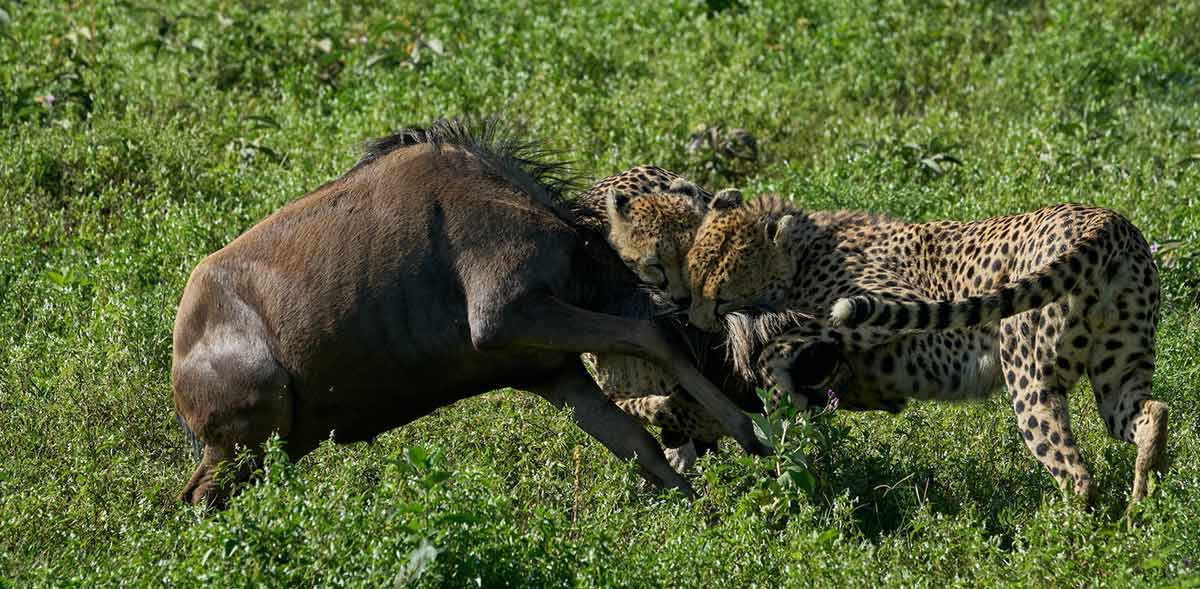
The Serengeti calving season is often associated with intense predator activity because large numbers of vulnerable young animals become available within a relatively concentrated area. However, predator encounters are not staged events. Animals move according to their own needs, and the presence of prey does not guarantee a hunt. Understanding this distinction helps set realistic expectations.
Lions and Wildebeest
Lions may patrol the plains, rest near grazing herds or investigate opportunities to hunt. Their behavior depends on factors including hunger, group size, prey availability and the surrounding terrain.
Watching a pride move through the grasslands can be fascinating even when no hunt occurs.
Cheetahs and Newborn Calves
Cheetahs may use the open plains to search for prey and take advantage of opportunities when conditions are favorable.
Their hunting attempts are fast and unpredictable, and a sighting should never be treated as a guaranteed performance.
A responsible safari gives wildlife the space to behave naturally while allowing visitors to observe from an appropriate distance.
Hyenas and the Wider Food Web
Spotted hyenas can be seen searching for food, interacting with other predators or moving through areas where herds gather.
Their role extends beyond scavenging. They are capable hunters and an important part of the Serengeti’s ecological balance.
Why You Should Allow Enough Time for Game Drives
The best wildlife encounters rarely follow a timetable.
A patient morning in a productive area may reveal more than a long drive between several distant locations. Likewise, a change in weather or animal movements can transform the quality of a game drive.
For this reason, we encourage travelers to allocate enough time to the southern Serengeti rather than treating the calving season as a brief stop on an overloaded itinerary.
If wildlife photography, predator behavior or newborn calves are your main priorities, additional nights can give your guide greater flexibility to explore different areas.
Is Serengeti Calving Season Better Than the River Crossing Season?
This is one of the most common questions travelers ask when planning a Great Migration safari.
Both periods can be extraordinary, but they offer different wildlife experiences.
The calving season generally focuses on the southern Serengeti and Ndutu, where large numbers of wildebeest gather to give birth.
The river crossing season is most closely associated with the herds’ movements through the northern Serengeti and the Mara River area, often during the middle and later parts of the year.
The famous crossings can be dramatic, but they are unpredictable. Herds may gather at a riverbank for hours or days before crossing, and not every group crosses at the same time.
Calving season offers a different kind of drama: newborn calves, large grazing herds and predator activity across open grasslands.
Which Experience Should You Choose?
Choose the calving season if you are particularly interested in newborn wildlife, animal behaviour, predator-prey interactions and photography across the southern plains.
Choose the river crossing season if your main objective is to experience the migration’s movements through the northern Serengeti and potentially witness a Mara River crossing.
Choose a longer migration-focused itinerary if you have enough time and budget to explore multiple regions, provided your travel dates align with the expected movements of the herds.
The most important consideration is that these are different seasonal experiences. Neither should be presented as a guaranteed wildlife spectacle.
At Gorilla Hour Uganda, we help you identify which period best matches your interests before recommending a route or accommodation.
Related guide: Serengeti Calving Season vs River Crossing Season.
How Much Does a Serengeti Calving Season Safari Cost?
The cost of a Serengeti calving season safari depends on several factors, including the number of days, accommodation category, transport arrangements, group size and the services included in your package.
A private luxury safari will generally cost more than a shared camping itinerary because of differences in accommodation, vehicle arrangements and service levels.
Factors That Influence Your Safari Cost
Accommodation: Luxury tented camps and premium lodges generally command higher rates than mid-range campsites and simpler accommodation.
Transport: Road safaris and fly-in safaris have different cost structures. Flights can save time but may increase the overall price.
Safari duration: Additional nights increase accommodation and guiding costs but also provide more opportunities for wildlife viewing.
Group size: Travelling privately as a couple or family may have a different per-person cost from joining a larger group.
Park and conservation fees: National park, conservation area and other applicable charges contribute to the final price.
Seasonal demand: Accommodation prices and availability vary, so booking early can be helpful for popular travel periods.
Additional destinations: Adding Ngorongoro Crater, Zanzibar or another national park introduces extra transport, accommodation and activity costs.
Planning your budget? Contact Gorilla Hour Uganda for a tailored quotation based on your dates, preferred accommodation, and travel arrangements.
Is the Serengeti Calving Season Suitable for Families?
Yes. A Serengeti calving season safari can be a memorable family experience, particularly for families interested in wildlife, nature and learning about animal behavior.
Children may find the newborn calves, zebras, elephants and other wildlife especially engaging.
However, the best family itinerary depends on the children’s ages, the length of travel days and the facilities available at the accommodation.
A private safari can offer greater flexibility, allowing the guide to adjust the pace and take breaks when necessary.
Families should also confirm the minimum age requirements for particular activities, as walking safaris and some specialist experiences may have restrictions.
For younger children, we often recommend avoiding unnecessarily long transfers and selecting accommodation with suitable facilities.
The aim is to create a safari that is enjoyable for the entire family, not simply to cover the greatest possible distance.
Can You Combine Serengeti Calving Season with Ngorongoro Crater?
Absolutely. The Serengeti and Ngorongoro Conservation Area are frequently combined in northern Tanzania safari itineraries.
The two destinations offer complementary experiences. The southern Serengeti and Ndutu are particularly important for calving-season wildlife, while Ngorongoro Crater provides a distinctive landscape where visitors can search for a rich variety of wildlife within a relatively concentrated area.
A combined itinerary can therefore introduce you to different habitats and wildlife-viewing opportunities within one holiday. The time required to move between destinations, the location of your accommodation and the number of game drives you want in the calving-season area will all affect the ideal itinerary.
If witnessing the wildebeest calving season is your main objective, do not sacrifice too much time in the southern Serengeti merely to add another destination.
A well-paced safari is usually more rewarding than an itinerary that attempts to include everything.
Explore our Serengeti and Ngorongoro safari itineraries.
Can You Combine Serengeti Calving Season with Zanzibar?
Yes. Combining a wildlife safari with a beach holiday in Zanzibar is an appealing way to experience two very different sides of Tanzania.
After several days exploring the Serengeti, you can travel to Zanzibar for white-sand beaches, Indian Ocean scenery, cultural experiences and time to relax.
This combination is particularly popular with couples, honeymooners and travellers who want a balance of adventure and rest.
A typical itinerary might begin with arrival in northern Tanzania, followed by several days in the southern Serengeti and Ndutu. Depending on the length of your holiday, you could then explore Ngorongoro before flying to Zanzibar.
Alternatively, a shorter itinerary can focus primarily on the calving season before continuing directly to the island.
Flight schedules, accommodation availability and the total number of days will determine the most practical arrangement.
Our recommendation: If witnessing the calving season is your main objective, allocate sufficient time to the Serengeti before travelling to the coast.
The beach is an excellent addition, but it should not come at the expense of the wildlife experience you travelled to Tanzania to enjoy.
Related guide: Serengeti Calving Season and Zanzibar Beach Holiday.
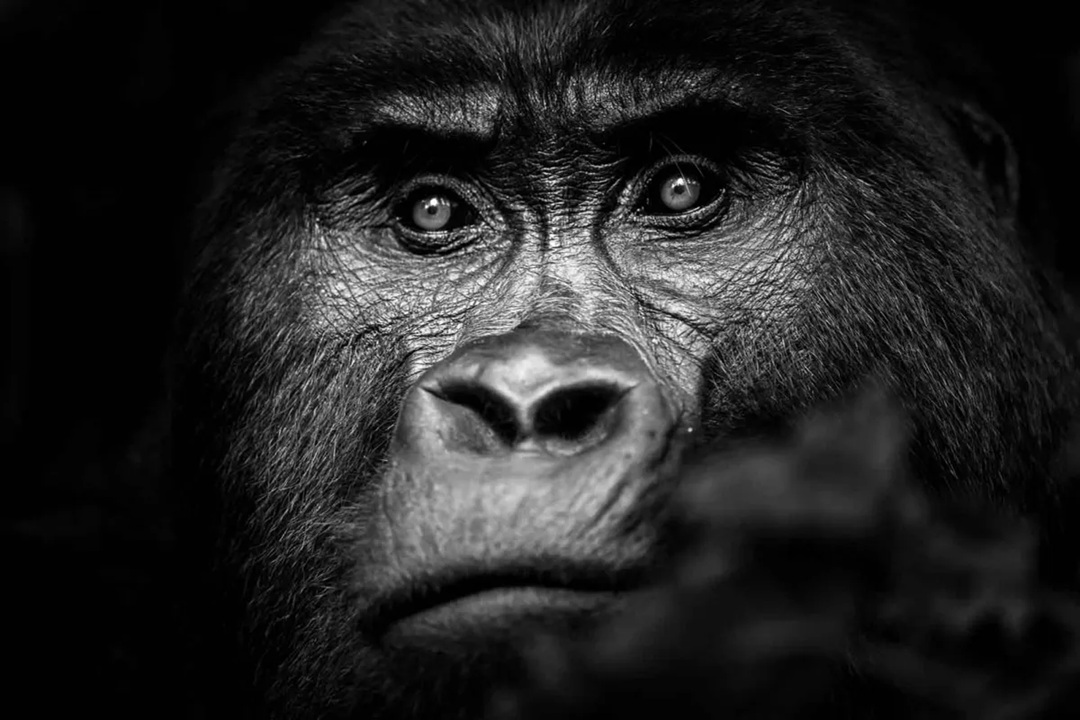
Can You Combine Serengeti Calving Season with Gorilla Trekking in Uganda or Rwanda?
For travelers seeking a more comprehensive East African adventure, combining the Serengeti calving season with mountain gorilla trekking can create an exceptional itinerary.
The two experiences are fundamentally different.
In Tanzania, you explore vast grasslands in a safari vehicle, following wildlife movements and observing animals within an expansive ecosystem.
In Uganda or Rwanda, gorilla tracking takes you into forested mountain habitats, where experienced trackers help locate a habituated mountain gorilla family.
The contrast between the open Serengeti plains and the mist-covered forests of the Albertine Rift makes this combination especially appealing to wildlife enthusiasts.
Uganda Gorilla Trekking and Serengeti Calving Season
A combined Uganda and Tanzania safari could include gorilla trekking in Bwindi Impenetrable National Park or Mgahinga Gorilla National Park, followed by a flight connection to Tanzania for the calving season.
Depending on your interests and available time, the Uganda portion may also include chimpanzee tracking, wildlife safaris or other experiences.
The itinerary needs to account for gorilla permit availability, flight schedules, transfer times and the location of your accommodation.
Rwanda Gorilla Trekking and Serengeti Calving Season
Rwanda offers another option for combining mountain gorilla trekking with a Tanzanian safari, check out our popular Rwanda Gorilla Trekking & Serengeti Safari
Travellers start the journey visiting first Volcanoes National Park before continuing to Tanzania, subject to suitable flight connections and the availability of permits and accommodation.
This arrangement can work particularly well for visitors seeking a relatively focused tracking gorillas Rwanda experience alongside the Great Migration.
How Many Days Should You Allow?
A combination safari generally requires more time than a Tanzania-only itinerary.
You need to account for international or regional flights, transfers, permit arrangements and sufficient time in each destination.
Rather than promising a fixed number of days for every traveler, we recommend tailoring the itinerary to your arrival point, budget and preferred pace.
At Gorilla Hour Uganda, we can help coordinate the different components so that the transition between destinations is as straightforward as possible.
Imagine beginning your journey among the newborn wildebeest of the Serengeti and continuing into the misty forests of Uganda or Rwanda to encounter mountain gorillas in their natural habitat. It is an extraordinary way to discover the diversity of East Africa.
Explore our Uganda Gorilla Trekking and Serengeti Calving Season Safari itineraries.
Why Choose Gorilla Hour Uganda for Your Serengeti Calving Season Safari?
At Gorilla Hour Uganda, we approach safari planning with a focus on the traveller’s priorities, the practical demands of the destination and the details that shape the overall journey. A safari is not simply a collection of hotel bookings, vehicle transfers and game drives. The quality of the experience depends on how those elements work together.
Witness the Serengeti Calving Season with Gorilla Hour Uganda
There are wildlife experiences that impress you with their scale, and there are experiences that stay with you because of their intimacy. The Serengeti calving season safari offers both. You can watch vast herds stretch across the southern plains, observe newborn wildebeest finding their footing and witness predators navigating an ecosystem shaped by the annual migration.
Every game drive offers a different perspective. One morning may be filled with the movement of thousands of animals; another may be defined by a quiet encounter between a mother and her calf.
The difference between simply visiting the Serengeti and experiencing it meaningfully often lies in the details: choosing the right season, staying in the right area, allowing enough time and travelling with a guide who understands the landscape.
At Gorilla Hour Uganda, we help bring those details together to create a safari that reflects your interests, travel style and expectations.
Whether you dream of a luxury tented camp in Ndutu, a private wildlife photography safari, a family adventure or an extended East African journey combining the Great Migration with mountain gorilla trekking, we can help you explore the possibilities.
Let us design your Serengeti calving season safari.
Tell us when you would like to travel, how you prefer to experience the wilderness and which destinations you would like to include.
Request your bespoke Serengeti safari with Gorilla Hour Uganda.
Gorilla Hour Uganda — Wildly Close.


