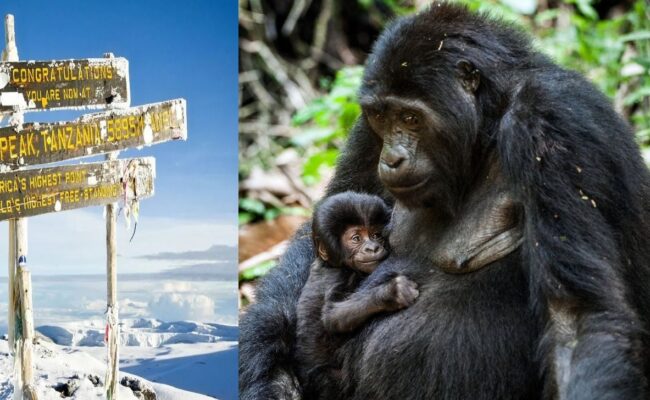
Mt Kilimanjaro Hiking and Gorilla Trekking
When hiking Mt Elgon, the Bushiyi trail is the newest route that offers hikers an off-the-beaten-path hiking experience



Here are the 20 gorilla facts as you plan to travel to Uganda or Rwanda for a Gorilla Tracking tour, which will deepen your appreciation for Mountain Gorillas. Mountain gorillas are intelligent, social, emotional, and remarkably human-like apes, and so fascinating to observe; it’s something about their presence, their whole being, that is passionate and inspiring, and that an encounter with these great giants does not leave you the same. Gorillas are found only in the misty mountain forests of Uganda, Rwanda, and the Democratic Republic of Congo, and their population has increased significantly due to ongoing conservation efforts and responsible tourism. These endangered great apes offer one of the rarest wildlife encounters on Earth: a one-hour gorilla encounter.
Many visitors experience quite the same at the first glimpse of a mountain gorilla; they call it an unforgettable, awesome, thrilling, once-in-a-lifetime moment just standing wildly close, only a few meters away, watching a silverback calmly observe his family, seeing playful juveniles tumble through the undergrowth, or locking eyes with a curious infant creates an emotional connection that few wildlife experiences can match.
3 Days Bwindi Gorilla Trekking Tour
3 Days Uganda Gorilla Habituation Experience
3 Days Rwanda Gorilla Trekking Tour
4 Days Uganda Gorilla Trekking Tour
5 Days Gorilla Trekking Tour
All our tours are tailored to fit your travel style, interests, time, and budget, so whether you’re planning your first gorilla trekking safari or want to learn more about these extraordinary animals, these fascinating gorilla facts reveal why they continue to inspire scientists, conservationists, photographers, and travelers from around the world.
Actually, mountain gorillas are among our closest living relatives, sharing approximately 98% of their genetic makeup with humans. This close evolutionary relationship explains why their behavior often feels remarkably familiar. They display affection, curiosity, playfulness, intelligence, and even grief. Observing a gorilla family in the wild often feels less like watching wildlife and more like witnessing another branch of our own family tree.
You can find mountain gorillas only in Uganda, Rwanda, & DR Congo. Unlike many wildlife species found across vast ranges, mountain gorillas survive naturally in only cool, mist-covered forest highlands within the Virunga Mountains within the conservation area that covers three countries, and it’s the only place in the world where gorillas live. Thus, gorilla tracking happens in Bwindi, Mgahinga, Volcanoes, and Virunga National Parks.
Mountain gorillas were once on the brink of extinction. Thanks to decades of conservation initiatives, anti-poaching patrols, veterinary care, habitat protection, and carefully managed gorilla tourism, their population has grown to more than 1,000 individuals.
They remain endangered, but they are one of the few great ape species whose numbers have increased in recent years a remarkable conservation success story.
Mountain gorillas live in stable family groups known as troops or families. Each family is led by a dominant silverback, an adult male distinguished by the silver hair across his back, whose role is to protect the family, resolve conflicts within, lead them on matters like where to feed, choosing nesting sites, defending the family from danger, and so many others. Strong leadership is essential to the survival of the family, and the silverback does it all too well.
Let’s take a look at the silverbacks. They have incredible physical strength possess incredible physical strength estimated to be several times stronger than an average human. They rarely use aggression unnecessarily.
Their famous chest-beating display is usually intended as communication rather than violence. Most encounters between gorilla groups are resolved through displays, vocalizations, and body language instead of fighting.
Every gorilla has a unique way of identification, just like humans with unique fingerprints. Gorillas, too, are uniquely identified by their distinctive wrinkle patterns around their nostrils. These gorillas’ natural distinctive features help researchers to identify and differentiate each gorilla, and also continue to monitor each individual throughout their whole lifetime without ever having to use invasive methods.
Gorillas never dwell on the past; each day they craft a fresh nest, moving forward with quiet resilience. In the wild, mountain gorillas make new nests/beds every evening, and they never go back to sleep where they slept the previous night. Their nests are made with leaves, vines, branches, and vegetation. Very intelligent giants, adults usually build their beds on the ground for several reasons, whereas babies or younger ones often sleep in the trees, and by morning the old nest is abandoned, and a new one is made for the night.
Mountain gorillas have nothing much to engage in except they spend much of their day feeding; feeding influences their movements, influences where in the forest they spend the day and the night. They will move from place to place within their wild habitat searching for prime feeding locations; their diet is purely vegetation and fruits, their main comprises bamboo shoots, wild celery, Tree bark, leaves, roots, stems, and fruits. An adult is likely to consume up to 30 kilograms of vegetation daily to meet the demands of their bodies, as these foods are low in calories; that is why gorillas have to eat for many hours to meet the nutritional requirements.
Mountain gorillas rarely drink water, not like other many mammals that need to drink water; mountain gorillas do not have to because they obtain nearly all the required water content from the plants they consume. The fresh bamboo shoots, leaves, and stems- all the vegetation they consume contain enough moisture to keep them hydrated, meaning they seldom drink directly from rivers or streams.
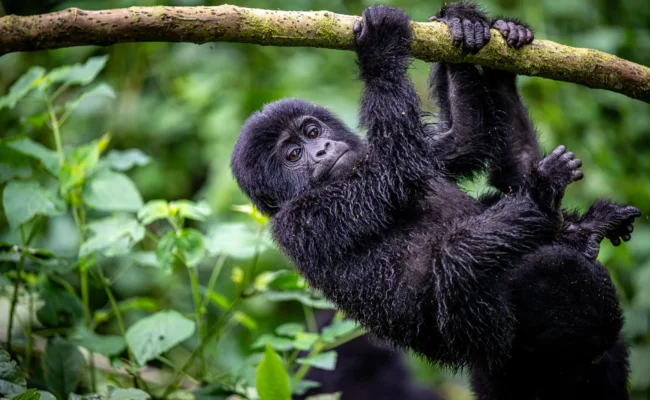
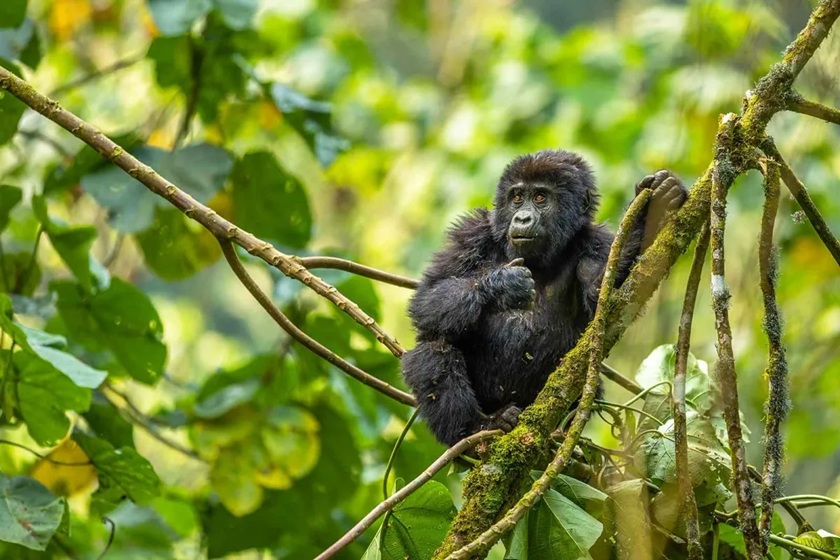
Young gorillas spend hours climbing trees, swinging on vines, chasing siblings, wrestling, and exploring their surroundings.
This play is not only entertaining to watch during gorilla trekking but also helps young gorillas develop strength, coordination, and important social skills.
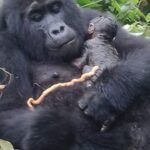
In general, mountain gorillas are tightly woven to their families, and more so for the Female gorillas. Mother gorillas are exceptionally devoted to their babies; they carry their babies almost constantly during the first months of life. Even as infants grow, they remain very close to their mothers for several years, learning survival skills and social behaviors. Mother gorilla and the baby gorilla share very strong bonds; in fact, the strongest within the gorilla family.
Gorillas are social animals with strong relationships within their family; what keeps these strong relationships is emotion. Within their family, they comfort each other, especially if one member is distressed; they mourn the loss of relatives. They show several emotions; they can express happiness, sadness, anxiety, grief, curiosity, affection, and compassion. Scientists have documented gorillas expressing a wide range of emotions and how these emotions form lifelong social bonds.
Gorillas have a language by which they communicate to one another within the family and also to other wildlife in their environment. The communication extends far beyond the famous chest beat that we all know of. The gorillas use more than 25 different vocalizations depending on the situation, and all mean different things. These include
Grunts, Hoots, Barking sounds, Roars, Soft humming during feeding. They also use body language to communicate; their facial expressions, their posture, eye contact, and touch are equally important parts of their communication.
Mountain gorillas live in highland forests between 2,200 and 4,300 meters (7,200–14,100 feet) above sea level. In these quiet, elevated forests, gorillas find both nourishment and refuge; it’s their natural environment that allows them to thrive. The mist-covered highlands offer the cool climate, dense vegetation for food, and the isolation they need. The volcanic slopes of Bwindi and the Virunga Mountains are decorated with bamboo and montane forests profiting abundant food and shelter for the gorilla families. Their thick fur is perfectly adapted to the chilly air, while the rugged terrain keeps them safe from predators and human disturbance.
These cool highlands and dense forests make it a magical setting for gorilla trekking, where visitors experience the wonder of entering the thick mist-covered forests searching for the mountain gorillas and get to experience what it is like standing a few meters away from the gorillas, observing them, watching them behave just as humans do.
Mountain gorillas live in families; some families are small, others can go to more than twenty individuals. Their family consists of one or more silverbacks, Adult females, Blackback males, Juveniles, and infants.
Two silverbacks can live in the same family, but their roles are very different. Only one dominant silverback – the alpha male- leads the family, makes decisions, protects the members, and controls the mating rights. A second silverback remains in the group as a subordinate and helps with the protection and cohesion but without full authority. This arrangement is most common in larger families where the dominant male tolerates the presence of another mature male, especially if they are related, like father -son or brothers. Over time, the younger silverback may leave to form his own group, or he may stay and support the troop until circumstances change.
Despite their intimidating appearance, mountain gorillas avoid conflict whenever possible.
Researchers who have spent decades studying gorillas consistently describe them as calm, curious, intelligent, and tolerant animals when humans respect established trekking guidelines. During gorilla trekking, visitors are briefed on the language and behaviors of the gorillas and are advised on what to do and what not to do before the gorillas in the one Gorilla Hour; this helps avoid agitation and confrontation, which is dangerous for both gorillas and the trekkers.
Another fact about Mountain Gorillas is that for every gorilla trekking permit purchased in Uganda or Rwanda, the proceeds contribute directly to protecting the gorillas and their environment through veterinary interventions cater for the staff in conservation. Ranger salaries, anti-poaching initiatives, community development, and conservation education. Gorilla numbers have significantly increased largely because of the responsible tourism that has become one of the most effective tools for protecting mountain gorillas and their habitat.
Visitors who go for gorilla trekking in Bwindi, Mgahinga in Uganda, or Volcanoes National Park in Rwanda are required to observe the major rule ‘One Gorilla Hour ’. This is emphasized to minimize stress and reduce disease transmission from humans to gorillas. Visitors are permitted to spend only one hour with a habituated gorilla family during a standard gorilla trekking experience and 4 hours for a Gorilla Habituation experience. This is carefully approach wis establised to protects both gorillas and visitors while preserving the authenticity of the encounter.
Because mountain gorillas are so closely related to humans, they are highly susceptible to many human illnesses, especially communicable diseases including respiratory infections.
For this reason, strict gorilla trekking rules were established that require visitors to maintain a safe distance, wear masks when necessary, avoid trekking when ill, and follow guidance from experienced park rangers.
Truth is, gorilla encounters are quite fascinating, and few wildlife encounters equal gorilla trekking, standing quietly in a rainforest for an hour while a family of mountain gorillas goes about its daily life just a few meters away.
Many travelers describe gorilla trekking as the highlight of their African safari, such a profound experience that fosters a deeper connection and intimacy with the great giants.
Understanding mountain gorillas before your gorilla trekking experience matters as it transforms the experience from simple wildlife viewing into a meaningful encounter with one of Earth’s most remarkable species. Every behavior you witness from a silverback’s protective watchfulness to the playful curiosity of young gorillas reflects the complex social lives of animals that share an extraordinary bond with humans.
When you book a gorilla trekking adventure in Uganda’s Bwindi Impenetrable National Park, Mgahinga Gorilla National Park, or Rwanda’s Volcanoes National Park, you’re not only embarking on a once-in-a-lifetime journey but also helping safeguard the future of these endangered great apes through sustainable tourism and conservation.

A curated list of the most popular travel packages based on different destinations.
When hiking Mt Elgon, the Bushiyi trail is the newest route that offers hikers an off-the-beaten-path hiking experience
The Real-Talk Guide to Uganda’s Gorilla Trekking Age Limit (2026/2027 Rules) If you are planning an East African family safari in 2026/2027, you have likely run into the golden rule of the jungle: you must be 15 years old to track mountain gorillas.But why exactly 15? What happens if your teen turns 15 during the […]
Kasenda Crater Lakes – Enjoy Uganda Safari’s Hidden Volcanic Gem, On a safari to Uganda, you get to enjoy many rare attractions
Explore the Wildlife That Makes Kenya a World-Class Safari Destination “From lions and elephants to cheetahs and giraffes, Kenya offers some of the most rewarding wildlife encounters on Earth.” -The warm Kenyan sun gently touches your face as you gaze out over endless plains. The air vibrates with the thrilling calls of the wild. Going […]
Can I Still Book My Uganda Safari for December 2026 – March 2027 ? Yes, You Can Still Book Your Uganda Safari for the 2026–2027 Season Nothing should hold down your Uganda dream safari, Ebola news spread widely, killing or putting on hold many travellers’ Uganda safari plans. Many are left wondering whether to […]
Bigodi Wetland Sanctuary is a swamp that covers approximately 4 km, featuring great vegetation and a forest that
An Adventurer’s Paradise Nestled in the heart of Uganda, Murchison Falls National Park is one of East Africa’s most captivating
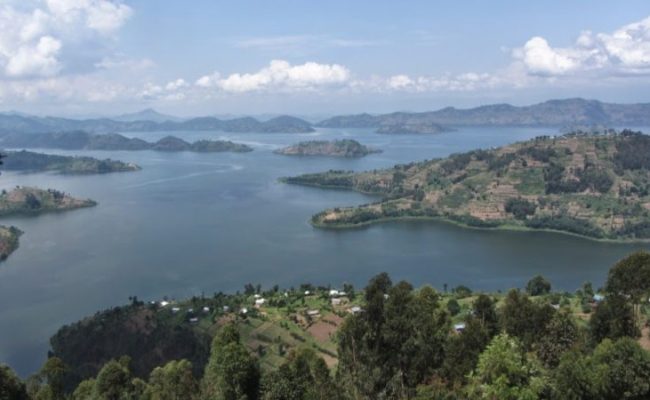
ake Burera and Ruhondo known as the twin lakes situated in the Virunga area, with beautiful landscapes