A Shoebill in Uganda: Prehistoric Bird Watching Adventure
Looking for where you can experience shoebill watching? This expert guide will help you know where to go for encounters with the shoebill in Uganda. As you plan your adventure, let me take you into Uganda’s natural habitats where shoebills thrive and how you can have the opportunity to watch this vulnerable species. Watching shoebills in Uganda is not confined to a single destination; rather, from the papyrus wilderness of Mabamba Swamp – Lake Victoria’s quieter bays to the expansive wetlands of the Nile Delta, and to the remote landscapes of western and eastern Uganda, different destinations reveal different sides of the Shoebill’s world.
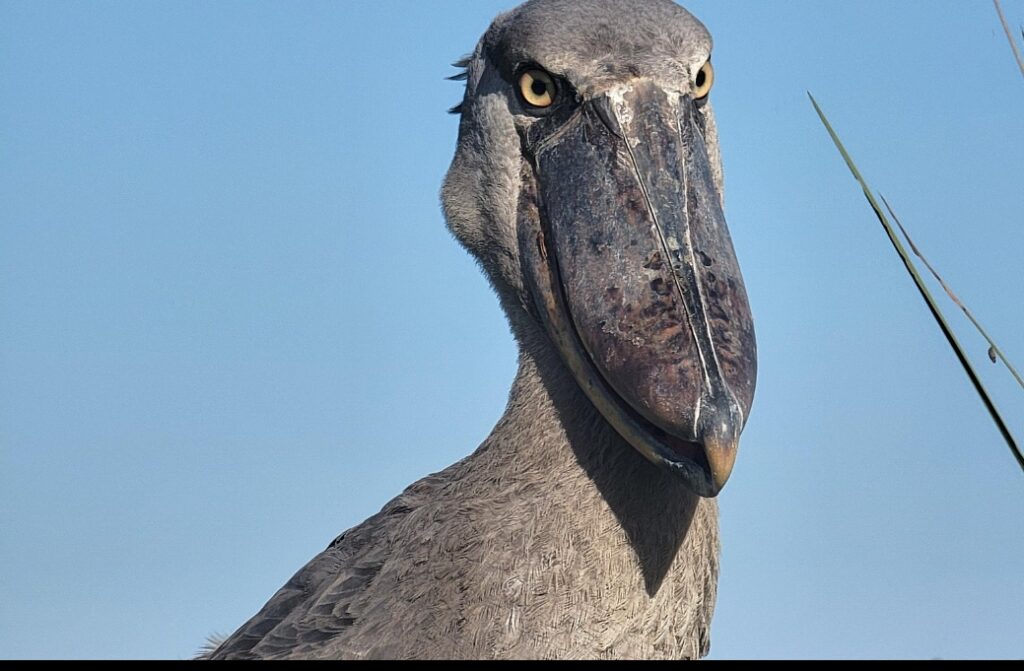
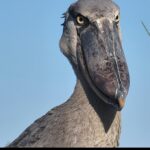
Mabamba Swamp adventure allows you to see the shoebill in Uganda. You start at the shores of Lake Victoria and enter the Mabamba Swamp, gliding in a traditional motorized boat. As you get to the edge of the swamp, you switch to take a canoe ride into the papyrus reeds that is able to glide silently through a maze of papyrus channels. Pay attention to when your guide slows or pauses the canoe, pulls up the binoculars, and searches the reeds for signs of the shoebill; if spotted, they will signal to you, meaning you are close, and you will be advised to stop talking, as your voices may scare away the bird. Then you spot the shoebill standing motionless among the reeds, watching this most extraordinary bird in their natural habitat in Uganda’s wetlands. Seeing a Shoebill in Uganda is not simply another item on a bird checklist; it is an encounter with a bird so unusual that it looks prehistoric, with its enormous shoe-shaped bill, tall stature, piercing eyes, and remarkable stillness. The Shoebill (Balaeniceps rex) is one of Uganda’s most sought-after wetland birds.
Where Can You See a Shoebill in Uganda?
If you are interested in searching for shoebills in Uganda, the experience is particularly special because Uganda’s extensive wetlands provide important Shoebill habitat. Among the country’s best-known shoebill destinations in Uganda is Mabamba Swamp, close to Entebbe and Lake Victoria.
This is what makes Mabamba and shoebill watching in general adventurous: you don’t just drive to a viewing platform and wait for a bird to appear; you enter a papyrus wetland by canoe. You move slowly through the wetland while your guide scans the vegetation and listens for movement, even as you glide by many other wetland birds appear along the way, so even before you find your main target, Mabamba is already alive with birdlife and beautiful water plants.
The wetland is characterized by papyrus, reeds, shallow channels, and open areas of water. These conditions create an ideal landscape for a bird that spends much of its time patiently waiting for prey.
Shoebill watching in Uganda is interesting, and you have many chances of spotting this iconic bird, but the most accessible destination of all is Mabamba Swamp, on the northern shores of Lake Victoria, west of Entebbe. Mabamba’s extensive papyrus wetland provides the shallow-water habitat the Shoebill depends on, and its proximity to Entebbe makes it particularly convenient for travelers arriving or departing through Uganda.
Other shoebill destinations in Uganda besides Mabamba Swamp for watching the shoebill in Uganda are Murchison Falls National Park around the Delta Sector, Lake Mburo National Park, Ziwa Rhino Sanctuary & Queen Elizabeth National Park, Semuliki, Lutembe Bay, Sango Bay–Musambwa Island–Kagera Wetland System, but Mabamba Swamp stands above them all. Mabamba is much more especially attractive because the birding experience is focused specifically on searching for the Shoebill in its natural habitat. Entering Mabamba Wetland and exploring it by canoe searching for the shoebill is quite an experience; it feels more earned.
What Does a Shoebill Look Like?
Here is what the shoebill looks like by features: it is an enormous wetland bird with a massive shoe-shaped bill, a tall, upright body, long legs adapted to shallow wetlands, broad wings, grey-blue plumage, a distinctive hooked bill tip, and an intense, almost prehistoric appearance, but the bill is its defining feature.
It is exceptionally large and powerful, allowing the Shoebill to seize fish and other wetland prey. But the most fascinating characteristic is its stillness; a Shoebill may stand motionless for surprisingly long periods. Then, without much warning, it can launch into action. That contrast almost complete stillness followed by an explosive strike is part of what makes watching one so fascinating.
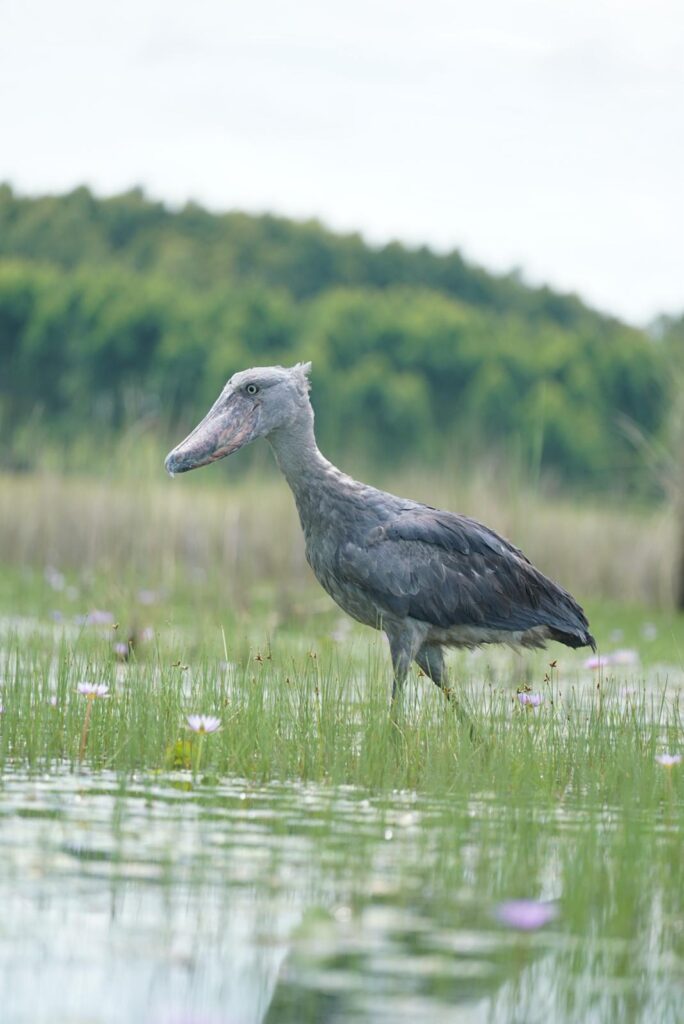
Despite the name sometimes used for it, Shoebill Stork, the Shoebill is not a true stork. The preferred name is simply Shoebill, or its scientific name, Balaeniceps rex. It is a distinctive lineage of African wetland birds with no close equivalent in the experience it offers birdwatchers.
Why the Shoebill Matters
The Shoebill is a globally threatened species and is classified as Vulnerable.
BirdLife International identifies habitat loss, degradation, disturbance, nest destruction, illegal capture, and other human pressures among the threats facing the species. Uganda has approximately 1,000–1,500 Shoebills nationally and identifies wetland drainage and degradation, disturbance associated with fishing and tourism, illegal capture for wildlife trade, and climate-driven habitat changes as key threats according to the Uganda Wildlife Authority.
The Shoebill is described as a large, prehistoric-looking freshwater wetland bird and the only species in the genus Balaeniceps. Its appearance is only part of the fascination, but so watching its behavior and gliding on boat or canoe to watching site is quite adventurous.
When Is the Best Time to See a Shoebill in Uganda?
For a dedicated Shoebill experience, early morning and evenings are particularly attractive.
The cooler hours can provide pleasant conditions for canoeing and active birding, while the soft morning light is also valuable for photography.
A specialist birding itinerary can also be arranged around your broader Uganda safari.
When visiting Murchison, you can take a boat ride to the delta sector or do birdwatching at Ziwa Rhino Sanctuary. All the way to Queen Elizabeth, Semliki, or in Lake Mburo shoebill watching can be curated into your Uganda itineraries, blending perfectly into a classic safari.
If you are already staying in Entebbe, shoebill watching in Mabamba can work beautifully as:
- An arrival-day experience
- A pre-safari excursion
- A departure-day activity, with sufficient time before your flight
- A dedicated half-day birding experience
- As part of a longer Uganda birding safari
Shoebill Uganda and Gorilla Trekking
Here is where I would encourage travelers to think beyond a simple half-day excursion.
If you are already coming to Uganda for gorilla trekking, you can combine two very different wildlife experiences.
Start with the wetlands around Entebbe, Search for the Shoebill and then travel west toward Bwindi Impenetrable National Park, Uganda. Eventually, the landscape changes from papyrus wetlands to montane forest.
And your wildlife experience changes with it.
One day you are watching a prehistoric-looking wetland bird from a canoe.
A few days later, you are standing in the misty forest of Bwindi watching a mountain gorilla family.
How Long Should You Spend at Mabamba?
For a traveler primarily interested in seeing the Shoebill, a half-day experience can work well.
However, if you are a serious birder or photographer, I recommend allowing more time.
You may want to explore additional channels, photograph other wetland species, and simply slow down.
The best birding experiences are rarely the ones where you spend the entire day watching the clock.
Plan Your Shoebill Experience with Gorilla Hour
At Gorilla Hour, we design your round shoebill watching experiences
We look at the entire journey.
Your arrival in Entebbe and connecting arrival with Mabamba shoebill watching
Your time around Lake Victoria.
Your specialist birding interests, where we combine the Shoebill watching with a wider Uganda birding safari.
Your onward journey to Uganda’s forests, savannahs or mountains. Where we combine the Shoebill experience with gorilla tracking and chimpanzee tracking.
Shoebill can be the beginning of an extraordinary Uganda safari, then go deeper into Uganda.
From a focused Mabamba Shoebill day trip to a comprehensive Uganda birding safari, we design the journey around what you genuinely want to see.